

Below is a fully rewritten, original version based on the BIS paper and current XRPL information, with fresh visuals and charts added. The factual claims that depend on current or primary sources are cited.
Created with [AIPRM Prompt “Human Written |100% Unique |SEO Optimised Article”]
BIS Tests XRP Ledger for Verifying Official Statistics: What It Means for XRP
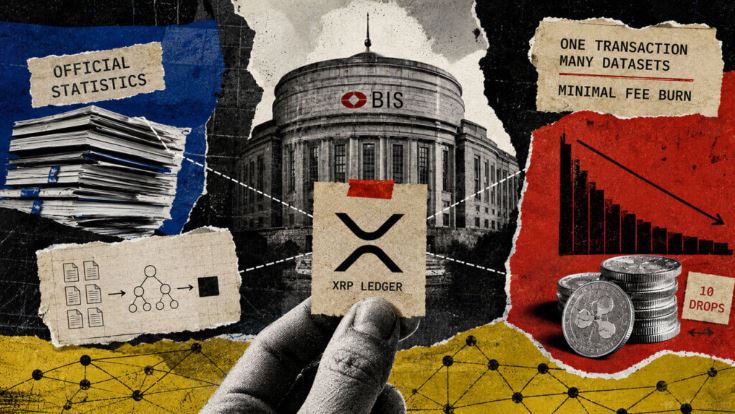
The Bank for International Settlements (BIS) has published research exploring how blockchain technology could help people verify whether official statistical data is authentic and unchanged. The work, published as BIS Working Paper No. 1374 on September 2, 2026, presents a proof-of-concept system built around the XRP Ledger (XRPL). Rather than putting sensitive economic statistics directly onto a blockchain, the system creates cryptographic fingerprints of statistical files and records a compact summary of those fingerprints on the ledger.
The distinction is important because this is not a proposal to turn the XRP Ledger into a giant public database. The underlying statistics remain outside the blockchain, while XRPL provides a publicly verifiable reference that can later be used to determine whether a published file has been modified. In simple terms, the blockchain works more like a tamper-evident notary than a traditional data-storage system. The BIS researchers reported median publication times of roughly three to five seconds and verification times of approximately one to two seconds during controlled prototype testing.
For XRP, the development creates an interesting but nuanced story. The research demonstrates that XRPL can support an institutional-style data-integrity application, but it does not automatically translate into large XRP demand. The system is specifically designed to reduce on-chain activity through batching, meaning thousands of datasets can potentially be represented by a single blockchain commitment. That makes the technology efficient, but it also means the direct amount of XRP destroyed through transaction fees can remain extremely small compared with the amount of information being authenticated.
BIS Working Paper 1374 Brings Blockchain Into Official Statistics
Official statistics play a much bigger role in the global economy than many people realize. Central banks, governments, financial institutions, economists and businesses rely on published datasets to understand inflation, employment, economic growth, trade and financial conditions. When those numbers are distributed across websites, databases, third-party platforms and automated systems, users need confidence that the information they received is actually the information originally released by the institution.
The BIS paper focuses on precisely that problem. According to the authors, SDMX, the international standard used to exchange statistical data and metadata, does not itself provide a cryptographic mechanism allowing a recipient to independently confirm that a dataset originated from its stated publisher and has remained unchanged. The proposed blockchain-based system is intended to add that missing verification layer without requiring statistical agencies to completely redesign their existing publication workflows.
The research was published officially by the BIS on September 2, 2026, as Working Paper No. 1374. The authors are Mario Rusev, Rafael Schmidt, Edward Lambe, Christian Schmieder and Glenn Philip Tice. As with other BIS Working Papers, the institution notes that the views expressed are those of the authors and do not necessarily represent the views of the BIS itself.
That distinction matters when discussing XRP. The paper should not be interpreted as a formal BIS endorsement of XRP as an investment, nor does it establish that the BIS intends to deploy the technology on XRPL at scale. What it does provide is something more specific: a technical demonstration that an XRPL-based architecture can be used to anchor cryptographic commitments associated with official statistical data.
How the XRP Ledger Verification System Works
The concept becomes easier to understand when broken into several stages. First, a statistical authority produces an SDMX file containing the relevant data. Instead of sending the complete file to the blockchain, the system calculates a cryptographic fingerprint of the file, or of individual statistical series where required.
A cryptographic hash behaves somewhat like a digital fingerprint. If the original file is changed—even by a tiny amount—the resulting fingerprint should also change. This gives a recipient a way to compare the fingerprint generated from the file they received with the fingerprint associated with the publisher’s original commitment.
The prototype then uses a Merkle tree to combine multiple fingerprints into a single summary value called a Merkle root. This is the key to the system’s scalability. Rather than placing a separate blockchain transaction on XRPL for every individual dataset, the system can group many datasets together and commit one root to the ledger.
The final step is the blockchain anchoring process. The Merkle root is placed into the memo field of an XRPL transaction, while the original statistical data and operational information remain off-chain. The published SDMX file contains information that allows a recipient to reconstruct the relevant cryptographic proof and compare the result against the value recorded on the ledger.
That architecture produces an important separation: the blockchain proves integrity without becoming the database.
Why Merkle Trees Matter for XRPL
Imagine a government agency publishes 1,000 statistical datasets. A basic blockchain approach could potentially require 1,000 separate on-chain commitments. That would increase transaction activity and fees.
A Merkle-tree design takes a different approach. The fingerprints of those datasets can be combined mathematically until the entire collection is represented by one final root. The root can then be anchored to the blockchain, while the individual fingerprints remain available as part of the verification material.
This is similar to placing 1,000 documents inside a secure warehouse and recording one highly specific seal representing the entire collection. Someone who later receives one document does not need the entire warehouse to verify it. They need the document’s fingerprint, the appropriate proof path and the publicly recorded root.
The BIS paper specifically uses this batching mechanism to reduce the on-chain cost of the proposed system. The research says that once reasonable batch sizes are used, the blockchain fee becomes negligible compared with ordinary processing and storage expenses. At the same time, larger batches introduce a trade-off because publishers may need to wait for more datasets before submitting a commitment.
That trade-off becomes particularly important for time-sensitive statistics. A monthly economic report can potentially tolerate a small batching delay, while a rapidly changing financial dataset may require faster publication. The BIS researchers therefore examine the relationship between batch size, latency and cost rather than treating maximum batching as automatically optimal.
Prototype Performance Shows Fast Verification
One of the more interesting findings is the speed of the experimental system. Under the controlled conditions described in the paper, the prototype recorded median publication latency of approximately 3–5 seconds, while verification generally took around 1–2 seconds.
Those numbers suggest that blockchain-based verification does not necessarily have to feel slow to an end user. If implemented properly, a statistical consumer could theoretically receive a file, perform a cryptographic verification and check the blockchain reference within seconds.
That could become particularly relevant as automated systems consume more economic data. Artificial intelligence systems, financial applications and data aggregators increasingly process information without a human manually checking every source. A machine-readable integrity mechanism could give these systems a way to establish whether a particular dataset matches an authenticated publication.
Still, the numbers should be kept in context. The BIS describes the system as a proof of concept, not a production-ready deployment. The measurements were produced in controlled testing rather than under every condition that could exist in a large-scale institutional environment.
The distinction between a prototype and a production system is therefore crucial. The experiment demonstrates feasibility, not guaranteed real-world performance.
XRPL Is Used as a Public Timestamp and Integrity Layer
The role assigned to XRPL in the prototype is relatively narrow but useful. The ledger does not need to understand the economic meaning of the statistical data. It only needs to provide a public, timestamped and difficult-to-alter record of the cryptographic commitment.
That makes the blockchain comparable to an independent verification layer. If a publisher releases a dataset today and someone modifies it tomorrow, the altered version should generate a different cryptographic fingerprint. The recipient can calculate the fingerprint again and determine whether it matches the original commitment.
This architecture can also help address a growing problem in digital information: data can be copied and redistributed without its original context. A statistical figure might appear on a website, inside a research report or in an AI-generated answer, but the person consuming the number may not know whether it matches the original publication.
The blockchain cannot prove that the original statistic itself is economically correct. That distinction is extremely important. If an institution publishes an incorrect inflation figure, cryptographic verification will not magically correct it. Instead, the technology can help prove that the file being examined is the same file that the publisher originally committed.
The system therefore addresses authenticity and integrity, not the underlying truthfulness of the statistic.
Why the BIS Research Matters for XRP
For XRP investors and XRPL supporters, the most interesting aspect is the institutional nature of the experiment. The BIS is one of the world’s major international financial institutions, and its researchers have explored whether a public blockchain can solve a practical problem involving official financial and economic information.
That does not mean XRP has suddenly become essential to global statistics. The paper explicitly makes the blockchain interface replaceable, meaning another blockchain could potentially be used to provide the same anchoring function. The researchers selected XRPL based on characteristics including low nominal transaction costs, fast finality and available developer resources.
That flexibility limits the investment conclusion but strengthens the technology conclusion. The research is effectively saying that this class of blockchain architecture can perform the job, and XRPL was suitable for the prototype.
This creates a two-sided story for XRP.
On one side, the project gives XRPL an additional institutional use case beyond payments and token-related applications. On the other side, the architecture intentionally minimizes blockchain transactions by combining large groups of datasets into single commitments.
That means network utility and XRP value capture are not automatically the same thing.
The XRP Fee-Burn Question
The XRP Ledger’s transaction-fee model is particularly important when evaluating the potential token impact. XRPL currently lists 10 drops, or 0.00001 XRP, as the minimum transaction cost for a standard transaction under normal conditions. The XRP used for the transaction fee is destroyed rather than paid to validators. The actual fee can increase when network load rises.
This produces a simple mathematical relationship:
XRP burned = number of transactions × XRP fee per transaction
But the BIS prototype introduces another variable:
datasets represented by each transaction
If one transaction represents 1,000 datasets, the number of datasets can increase dramatically without producing the same increase in transaction count.
For example, using the current 10-drop base fee as a purely illustrative calculation:
If one million datasets were individually anchored, the theoretical base-fee burn would be 10 XRP. If the same one million datasets were divided into 1,000 anchors containing 1,000 datasets each, the base-fee burn would be only 0.01 XRP.
The difference is enormous, and it explains why the BIS prototype’s technological scalability does not automatically produce massive XRP fee consumption.
The calculations above are illustrations rather than a forecast. Real-world fees can change with network load, transaction type and future protocol changes. XRPL itself states that the standard base transaction cost can increase under higher network load.
The Batch-Size Trade-Off
Batching is one of the strongest parts of the system from an engineering perspective. It allows the blockchain to authenticate large amounts of information without requiring an equal number of transactions.
But there is a trade-off.
Suppose a publisher wants to authenticate datasets as cheaply as possible. It could wait until a very large number of datasets have accumulated and then create one blockchain commitment. That would minimize transaction costs per dataset.
The problem is delay.
If the publisher has a dataset that needs to be authenticated immediately, waiting for hundreds or thousands of additional datasets could reduce the usefulness of the system. The BIS paper therefore examines the balance between cost efficiency and publication latency and derives an economically optimal batching approach under its model.
This is one of the reasons the project is more interesting than simply saying “BIS used XRP.” The research explores an actual operational problem: how do you get blockchain’s integrity benefits without turning every statistical release into an expensive or slow process?
The answer is not maximum blockchain activity. It is selective anchoring.
XRPL Reserves Add Another Potential XRP Requirement
Transaction fees are not the only XRP-related mechanism. XRPL also uses account and owner reserves to protect the ledger from excessive ledger-object creation.
According to current XRPL documentation, the base account reserve is 1 XRP, while the owner reserve is 0.2 XRP per qualifying ledger object. These values can be changed through the network’s fee-voting process.
This creates a second potential source of XRP requirements in an institutional deployment.
If organizations create multiple XRPL accounts or ledger objects, some XRP could need to remain locked as reserves. However, this should not be confused with transaction fees. Reserved XRP is not automatically destroyed in the same way as transaction fees.
That difference matters when estimating potential token economics.
An organization could potentially process a huge number of statistical files through one established account without creating a new account for every dataset. Under such an architecture, dataset throughput could grow rapidly while reserve requirements remain relatively stable.
The exact XRP requirement would therefore depend heavily on how a production system is designed.
The Difference Between XRPL Usage and XRP Demand
This is probably the most important point for anyone analyzing the announcement.
XRPL adoption does not automatically equal proportional XRP price appreciation.
A network can become more useful while requiring relatively little XRP per operation. The BIS prototype is an excellent example because its primary goal is efficient authentication, not maximizing blockchain transactions.
If an organization processes millions of datasets but compresses them into a relatively small number of blockchain commitments, the amount of XRP consumed by fees could remain tiny.
On the other hand, broader adoption could still create indirect economic effects. More institutions using XRPL could increase ecosystem visibility, encourage developers to build additional applications and create demand for XRP for fees, reserves or other XRPL-native activity.
Those possibilities are separate from what the BIS prototype itself demonstrated.
The paper provides evidence of technical feasibility, not a forecast for XRP market capitalization.
Current XRP Market Context
The BIS announcement arrives while XRP remains a highly active large-cap cryptocurrency. Current market reports on September 4, 2026 place XRP around the $1.40–$1.45 region, although cryptocurrency prices can change rapidly. One current market report put XRP near $1.45, while other intraday data showed the token pulling back toward the $1.39 area after a recent rally.
That makes the timing particularly interesting for market watchers. Positive institutional headlines can sometimes attract additional attention to an asset even when the underlying development does not immediately create measurable token demand.
The market should therefore separate three different questions:
- Is the technology useful?
- Will institutions actually deploy it?
- How much XRP would those deployments require?
The BIS paper provides encouraging evidence for the first question. It does not answer the second with a commercial commitment, and it provides only a model for thinking about the third.
That distinction can help prevent exaggerated claims surrounding the announcement.